Vehicle App/Service Simulation
Test and validate vehicle applications and services in a controlled simulation environment before deployment to real hardware. Accelerate development cycles while reducing costs and risks.
Technical Overview
Our Vehicle App/Service Simulation platform provides a comprehensive environment for developing, testing, and validating automotive software without requiring physical hardware. Built on industry-standard protocols and interfaces, the platform enables engineers to simulate complete vehicle systems including ECUs, sensors, actuators, and communication networks.
The simulation environment supports AUTOSAR Adaptive and Classic platforms, SOME/IP, DDS, and CAN/CAN-FD communication protocols. Engineers can create realistic test scenarios, inject faults, and validate system behavior under various conditions—all within a controlled, repeatable environment.
Integration with CI/CD pipelines enables automated testing at every stage of development, catching issues early and reducing the cost of defects. The platform scales from individual developer workstations to cloud-based test farms for large-scale validation campaigns.
Architecture Overview
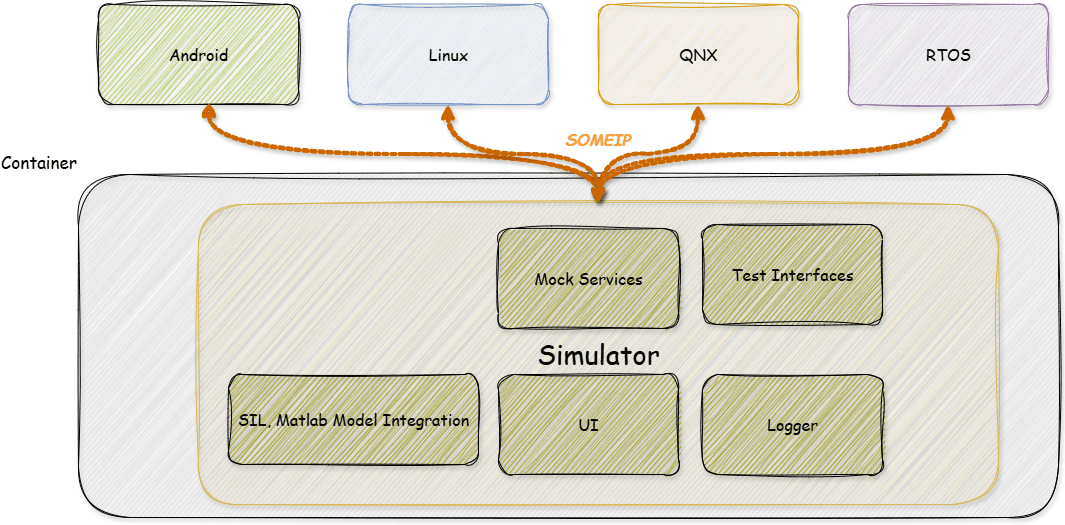
Automation:
- ARXML-driven ECU generation
- Automatic service code creation
- Mock service generation with GUI
Integration:
- SOME/IP protocol support
- SIL and Matlab/Simulink integration
- Multi-ECU network simulation
Key Capabilities
Iterate quickly on vehicle applications without waiting for hardware availability. Test new features and algorithms in minutes, not weeks.
Validate system behavior in dangerous or difficult-to-reproduce scenarios without risk to personnel or equipment.
Run thousands of test scenarios in parallel using cloud infrastructure. Achieve comprehensive test coverage in a fraction of the time.
Integrate simulation tests into your development pipeline for continuous validation and early defect detection.
Benefits
Reduce Development Costs
Minimize hardware dependencies and reduce the need for expensive test vehicles and equipment. Test early and often without physical constraints.
Accelerate Time to Market
Parallel development and testing workflows enable faster iteration cycles. Catch and fix issues earlier in the development process.
Improve Software Quality
Comprehensive test coverage including edge cases and fault scenarios that are difficult or impossible to test on real hardware.
Enable Remote Collaboration
Distributed teams can access the same simulation environment, facilitating collaboration across geographic boundaries.
Repeatable Test Scenarios
Create deterministic, reproducible test cases that can be run consistently across different environments and time periods.
Continuous Integration Ready
Automated simulation tests integrate seamlessly with modern DevOps practices and CI/CD pipelines.
Use Cases
Validate Advanced Driver Assistance Systems (ADAS) features such as adaptive cruise control, lane keeping assist, and automatic emergency braking in simulated traffic scenarios. Test sensor fusion algorithms with synthetic camera, radar, and lidar data.
Example: A Tier-1 supplier used our platform to validate their lane departure warning system across 10,000+ scenarios, reducing validation time by 60%.
Test infotainment applications, user interfaces, and multimedia features without requiring physical head units. Validate integration with vehicle systems, smartphone connectivity, and cloud services.
Example: An OEM validated their next-generation infotainment platform with simulated vehicle data, enabling parallel development with hardware teams.
Simulate ECU behavior for powertrain, chassis, body, and safety systems. Test control algorithms, communication protocols, and fault handling without physical ECUs. Validate software updates before deployment.
Example: A development team tested their battery management system software against 500+ fault scenarios, identifying critical issues before hardware integration.
Develop and test autonomous driving stacks in simulated environments with realistic traffic, weather, and road conditions. Validate perception, planning, and control algorithms across millions of virtual miles.
Example: An autonomous vehicle startup accelerated their development by running 24/7 simulations, achieving 10 million virtual test miles in 6 months.
Test vehicle cybersecurity defenses by simulating attack scenarios on communication networks, ECUs, and cloud connections. Validate intrusion detection systems and security protocols in a safe environment.
Example: A security team validated their intrusion detection system against 100+ attack patterns, improving detection rates by 40%.
Ready to Accelerate Your Vehicle Software Development?
Let's discuss how our Vehicle App/Service Simulation platform can help your team reduce costs, accelerate development, and improve software quality.